Zygomatic Implants: What They Are and When They’re Recommended
When there is significant bone loss in the upper jaw, many patients are told that “implants are no longer possible.” However, advanced alternatives exist that allow complex cases to be treated without relying solely on the upper jaw bone. One of these options is zygomatic implants. At AKDENT – Dental Clinic, we explain what they are, when they are recommended, and why they require highly specialized planning.
What are zygomatic implants? 🦷
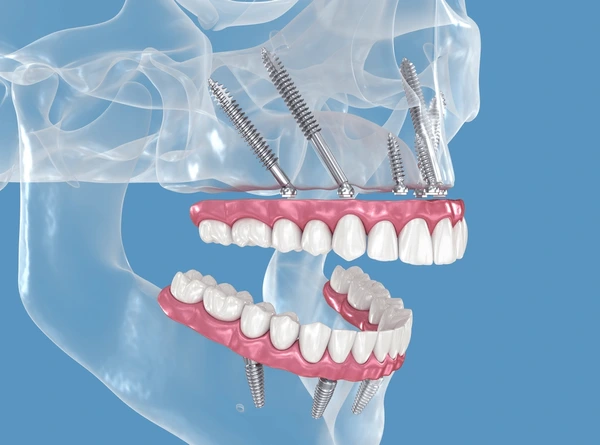
Zygomatic implants are longer implants that anchor into the zygoma (cheekbone) instead of relying only on the upper jaw (maxilla). They are mainly used to rehabilitate patients with severe maxillary atrophy, where there is not enough bone in the upper jaw to support conventional implants.
In simple terms, they use a stronger and denser bone structure to achieve stable support for a fixed prosthesis.
When are they recommended? 👤
Zygomatic implants are considered when traditional implants are not viable in the upper jaw due to insufficient bone or previous surgical failures. Common situations include:
- Severe upper jaw bone loss.
- Fully edentulous upper jaw with unstable dentures.
- Failure of previous implants in the maxilla.
- Cases where bone grafting would be complex or not desired by the patient.
- Need for fixed rehabilitation in advanced situations.
What advantages can they offer? ✅
In well-selected patients, zygomatic implants can provide an effective alternative to restore fixed teeth when traditional implants are not feasible.
- Alternative to bone grafting in certain cases.
- Anchorage in dense bone (zygoma) for enhanced stability.
- Possibility of fixed full-arch rehabilitation.
- In some protocols, combination with immediate loading may be possible.
Are they suitable for everyone? ⚠️
No. Zygomatic implants are an advanced solution and require strict clinical indication. They are not chosen by preference but because the case truly requires this approach.
Since they involve complex anatomical areas, experience and careful planning are essential.
How is a zygomatic implant case planned? 🔍
Planning is the key to success. Before recommending this treatment, a comprehensive evaluation is performed, typically including:
- Clinical examination of gums and oral tissues.
- 3D imaging to assess bone structure and sinus anatomy.
- Bite analysis and prosthetic planning.
- Design of the final fixed restoration and treatment phases.
What care is required afterward? 🧼
As with any implant treatment, maintenance is essential. In complex cases, oral hygiene and follow-up appointments become even more important.
- Daily hygiene with recommended techniques and tools.
- Regular check-ups to monitor gum health and prosthesis stability.
- Avoid excessive bite forces (especially if bruxism is present).
- Professional cleanings as advised.
Frequently asked questions 🗣️
Are they painful?
Discomfort is generally manageable with the prescribed post-operative care. At AKDENT, we explain the recovery protocol in detail.
Can I have fixed teeth with them?
In most cases, the goal is to provide a fixed full-arch prosthesis, depending on the individual plan.
Do they always avoid bone grafting?
Not always. Sometimes techniques are combined, but the approach depends on anatomy and treatment objectives.
How we assess it at AKDENT 🦷
At AKDENT – Dental Clinic, every case is evaluated individually. If there is insufficient bone in the upper jaw, we analyze all available options—conventional implants, grafting procedures, or advanced techniques—and recommend the safest and most predictable solution for your situation.
- Comprehensive 3D diagnosis.
- Prosthetic planning focused on stability and function.
- Long-term follow-up for durable results.
Conclusion: an advanced option for complex cases 🦷✨
Zygomatic implants allow patients with severe upper jaw bone loss to receive fixed rehabilitation when conventional implants are not viable. They are an advanced solution that requires accurate diagnosis, planning, and experience. At AKDENT, we carefully assess your case and guide you toward the safest and most appropriate treatment.
If you have been told you “don’t have enough bone” for implants, book your appointment at AKDENT and let us evaluate your options together.


